

The Four Failure Points Every Back Office Shares
Ask an AP manager what slows their team down and you will hear about invoices arriving in six different formats from four different channels. Ask an HR head and you will hear about employee documents and service requests sitting in a shared mailbox. Ask a sales head and you will hear about customer purchase orders being re-keyed by hand before an order can be booked.
Three different departments. Three different systems. Three different budgets. One identical problem.
Manual Handling
Repetitive keying and document checks consume capacity that should be going to judgment work, such as reviewing terms, resolving disputes, and handling the customer.
Disconnected Handoffs
Work moves through inboxes, spreadsheets and departmental queues. Nothing owns the whole path from arrival to resolution.
Changing Formats
Documents and requests arrive in inconsistent structures and channels, and the process bends around every variation.
Limited Visibility
Exceptions, ownership and outcomes are hard to see end to end, so problems surface as escalations rather than as data.
One Flow, Reused Across Every Process
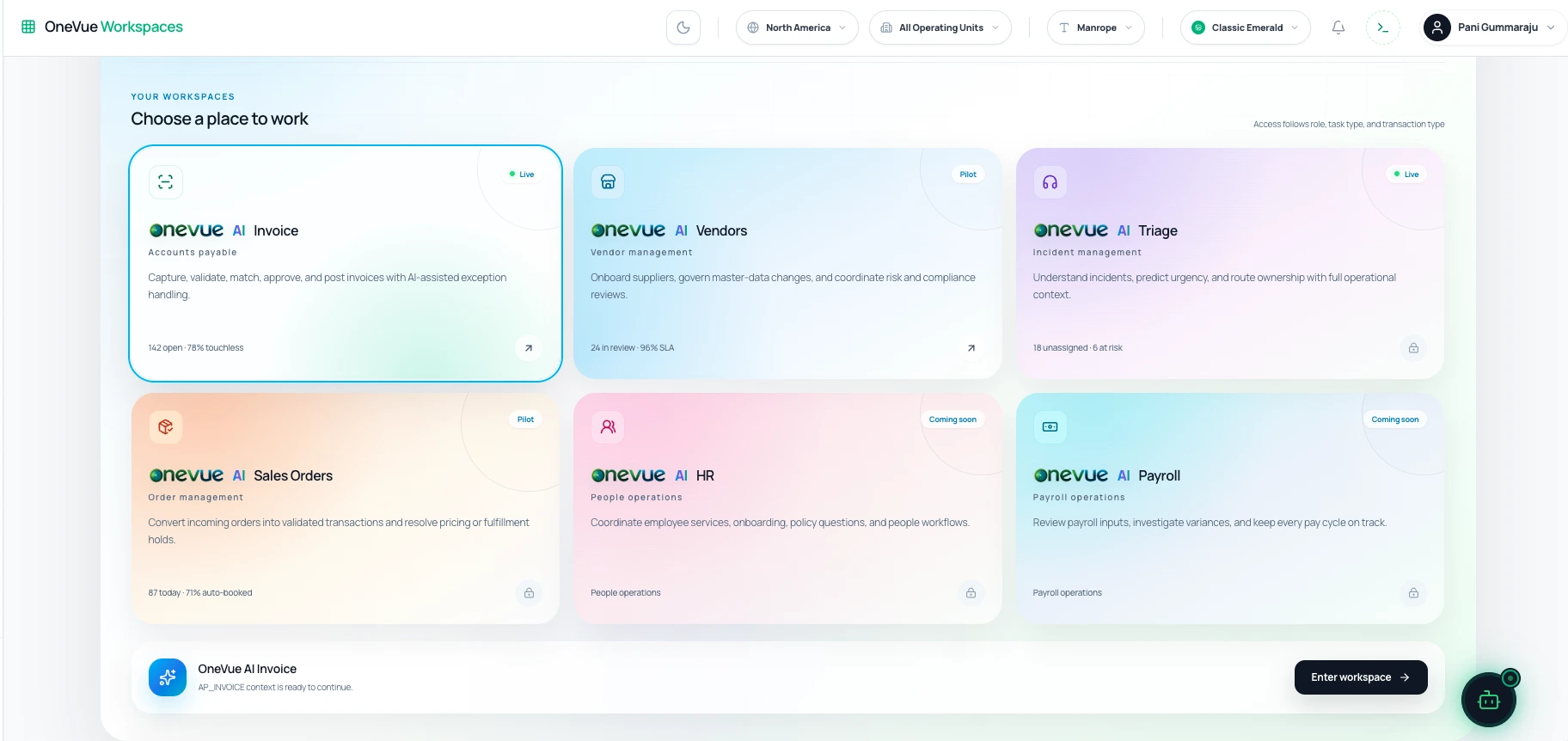
OneVue 2.0 takes a different starting position: instead of an application per department, it runs one operating model that every process inherits.
- ✓Capture: Email, shared folders, SharePoint, OneDrive and manual upload for PDFs, images, XML and more, classified on arrival.
- ✓AI Extract: Prompt-based extraction and classification, tuned per document type rather than trained per template.
- ✓Workflow: Rule-based validation, approvals and automatic exception routing, with the rules visible to the business.
- ✓Update the System of Record: Real-time, audited write-back to the ERP, ITSM or HRIS so the transaction lands where it belongs.
- ✓Insights: Dashboards on accuracy, throughput and cycle time, per process and per field.
The same five steps carry an invoice, a purchase order, an onboarding pack, a payroll input and an IT incident. What differs between them is configuration, not a new implementation.
What That Looks Like in Practice
The invoice journey is the clearest illustration, because most organisations already know how painful it is.
Invoices arrive into a single ingress view that polls mailboxes and folders, classifies each document (invoice, receipt, statement, utility, or other), and shows a live activity stream of what came in, from where, and what state it is in. Nothing sits unseen in someone's inbox.
When a supplier changes their layout, the extraction prompt is plain English: "Extract invoice header and line item details from the document." A business user edits it and re-extracts. There is no model retraining project and no ticket to IT, which is precisely why the same mechanism works just as well on an employee document or a customer PO.
Exceptions route themselves through a governed workstream with visible rule sets including vendor match, bill-to match, PO matching, coding, routing, notification and ERP mapping, so the path an item took, and who touched it, is a matter of record rather than recollection. Clean items post straight through to the ERP; only the genuine exceptions reach a person.
And when someone needs an answer, they ask for it in natural language. AskOneVue turns "show me all invoices for this month" into a table, with the option to visualise it without any report request or waiting for a dashboard change.
What This Means for Your Team
If You Run Accounts Payable
You get straight-through processing on the clean majority and a shorter, better-triaged exception queue on the rest. Extraction accuracy is measured field by field (invoice number, PO number, amount, vendor, tax, terms), so quality is a number you can manage rather than a feeling. Approvals, coding and routing rules stay visible to your team instead of living inside someone else's configuration file. The month-end spike stops being the moment the process buckles.
The part worth noting: the platform your AP team proves this on is the same one supplier onboarding and vendor master data will run on next.
If You Run HR
Employee documents and people-service requests arrive through the same capture layer, get understood the same way, and are actioned through the same workflow, with AskOneVue answering routine policy and status questions without a person opening a ticket. Onboarding packs, contract variations and payroll inputs stop living in a shared mailbox where ageing is invisible.
Because HR inherits the capture, workflow, integration and audit services that finance has already hardened, the HR case does not need to fund its own platform. It needs configuration and a use case.
If You Run Sales Operations
Customer purchase orders that arrive by email or portal are read, validated and turned into sales orders without re-keying, with pricing and fulfilment holds surfaced as exceptions rather than discovered late. Order acknowledgement gets faster, and the cost of that speed is not a new system your team has to learn.
The commercial argument is straightforward: revenue-side documents get the same automation maturity that AP has enjoyed for a decade, without a separate procurement cycle.
Why One Foundation Compounds and Point Tools Do Not
Strategic Advantages of a Unified Foundation
- ✓Start small, then compound: Go live with one process, then add the next as configuration, unlike traditional ERP implementations where each process carries significant setup costs.
- ✓Prompt-based, reusable AI: AskOneVue's prompt pattern carries learning from one process to the next with no re-installation or elaborate set-up.
- ✓Oracle-grade integration: Real-time, audited write-back to Oracle E-Business Suite, Fusion and WebCenter, backed by 15+ years of back-office delivery.
- ✓Proven in production: OneVue 2.0 is live at enterprise customers today, so the functional and non-functional bar is already met at enterprise scale.
The Outcome Leaders Actually Care About
Less repetitive handling. Greater consistency, because common rules and controls apply across teams instead of per department. Stronger traceability, because ownership, decisions and handoffs are visible. And exceptions that mean something, because the routine work no longer competes with the work that needs judgment.
“Clearer operations. Better control. More capacity for higher-value work. Start with one process. Scale across the enterprise.”
You do not have to choose which department wins the automation budget this year. Pick the process that hurts most (such as invoices, supplier onboarding, customer POs, employee documents, payroll inputs, or incident triage), prove it, and let the next process inherit what you built.